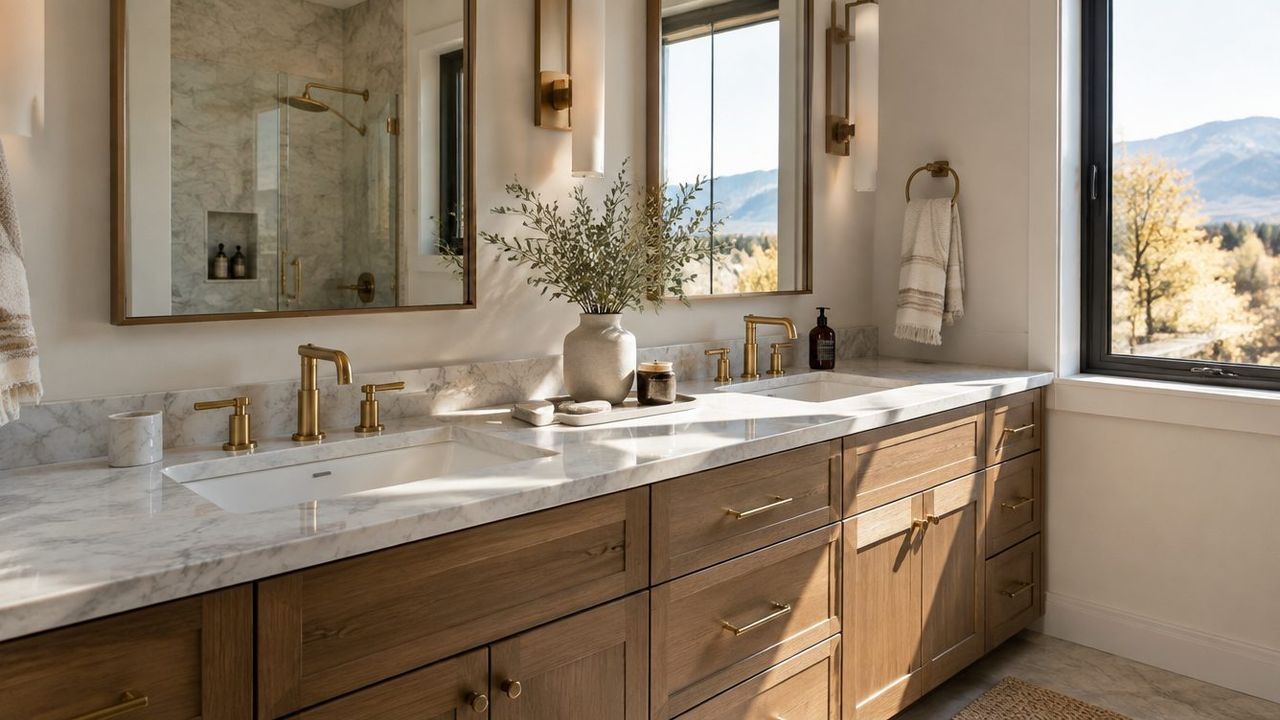
Early October is a practical time to plan a bathroom refresh before holiday guests arrive. The vanity top is a focused change that can reset the whole room without changing every surface. If you want help understanding natural materials first, read our guide to choosing natural stone for Colorado homes.
This guide compares the main vanity materials, explains sink and edge choices, and gives you a checklist for a clear written quote. It applies to homes in Highlands Ranch, Parker, Littleton, Centennial, and Castle Pines.
Caring for a new vanity top? See how often to seal natural stone.
What are the best bathroom countertop options?
Quartz, quartzite, granite, and marble are the strongest bathroom countertop options for most Colorado vanities. Quartz is consistent and easy to maintain. Quartzite and granite bring natural movement with strong durability. Marble gives a refined, timeless look but asks for more care. Your daily habits should guide the final choice.
Start with how the bathroom is used. A busy family bath often benefits from quartz or granite. A primary bath can be a good place for a distinctive quartzite slab. Marble suits homeowners who value its soft veining and accept that it will develop character with use.
Look at full slabs whenever possible. A small sample cannot show the movement, color shifts, or natural marks that will appear across a double vanity. Bring a cabinet door, tile sample, and faucet finish to the slab yard so every material can be viewed together.
How do quartz, quartzite, granite, and marble compare for a vanity?
Quartz offers predictable color and simple care, while quartzite and granite offer one-of-a-kind natural patterns with strong performance. Marble has the softest, most classic appearance, but it can etch and stain more readily. No material is best for every bathroom. The right one balances appearance, durability, upkeep, and budget.
| Material | Look | Durability | Upkeep | Good for |
|---|---|---|---|---|
| Quartz | Consistent color, subtle to bold patterns | Strong for daily bathroom use | Simple cleaning, no routine sealing | Busy family baths and clean modern designs |
| Quartzite | Natural movement, often marble-like | Hard and durable when properly selected | Seal as recommended for the stone | Statement primary vanities and double sinks |
| Granite | Natural crystals, depth, and broad color range | Dense and highly durable | Seal as recommended and use stone-safe cleaner | High-use bathrooms and richly textured rooms |
| Marble | Soft veining and classic character | More likely to etch or stain | Regular care, sealing, and gentle cleaning | Powder rooms and primary baths where patina is welcome |
Engineered quartz is not the same material as natural quartzite. The names sound similar, but the appearance, fabrication, and care are different. Ask to see the exact label and care guidance for any slab you are considering.
Which edge profiles and sink styles work best?
A simple eased edge works with nearly every bathroom, while a mitered edge creates a thicker, more architectural look. Undermount sinks keep the counter easy to wipe. Vessel sinks make a stronger visual statement. Integrated sinks offer a seamless result when the selected material and fabrication method support them.
Edge choice should fit the scale of the vanity. A heavy edge can overpower a small powder room but look balanced on a long double vanity. Softer rounded profiles are comfortable in family bathrooms. Clean square profiles pair well with slab-front cabinets and modern fixtures.
Sink style affects more than appearance. An undermount sink requires an accurate polished cutout. A vessel sink changes faucet height and placement. An integrated sink needs close coordination between the product, countertop fabricator, and installer. Confirm sink model numbers before templating so the openings are cut correctly.
How thick should a bathroom countertop be?
Bathroom countertop thickness should suit the slab, cabinet, edge profile, and overall design. Standard slab thickness can look clean and substantial on many vanities. A mitered edge can create a thicker appearance without using a solid block. The fabricator should confirm support, overhang, sink openings, and cabinet conditions before fabrication.
Thickness also changes how the faucet, sink, backsplash, and drawers fit. A taller built-up edge may affect the top drawer or the visual space below a mirror. A thinner profile can suit a light floating vanity, but it still needs proper support. Review a full-size edge sample instead of choosing from a small drawing.
What should a bathroom countertop quote include?
A bathroom countertop quote should identify the exact material and include every step from measuring through installation. It should also state who handles sinks, faucets, backsplash, removal, plumbing, sealing, and scheduling. A detailed written scope makes competing quotes easier to compare and prevents key tasks from being assumed by both sides.
What your bathroom countertop quote should cover:
- On-site templating and final measurements
- Slab or quartz selection, quantity, finish, and allowance details
- Fabrication and the selected edge profile
- Sink cutouts and finished cutout edges
- Faucet and accessory holes
- Backsplash material, height, edges, and installation
- Removal and disposal of the old vanity top
- Plumbing disconnect and reconnect, including who performs each task
- Sealing when the selected natural stone requires it
- Protection, cleanup, and a written schedule
The quote should also explain what happens if the cabinets are not level or if hidden damage appears after the old top is removed. Clear allowances and responsibilities matter more than vague promises.
How long does a vanity top replacement take?
The timeline depends on the material, slab availability, sink style, fabrication, backsplash, and what the old top reveals. A simple replacement and a custom double vanity do not follow the same schedule. Ask for a written timeline after the site measure, with separate dates for templating, fabrication, removal, plumbing, and installation.
If you want the bathroom ready before holiday guests arrive, begin the conversation in early October. That leaves more room for slab selection and coordination. Do not rely on a verbal estimate. The written schedule should identify decisions or products that must be ready before templating and install.
What else should you update with a new vanity top?
A vanity top often works best as part of a small group of coordinated changes. New faucets, mirrors, lighting, backsplash, or shower details can make the room feel complete. Keep the material palette focused. One strong natural stone can lead, while quieter tile and fixtures support it.
If the shower is also changing, read our Highlands Ranch tile shower installation guide. For another durable stone surface, compare finishes in our granite floor installation guide. Kitchen planning is covered in 2026 kitchen countertop trends.
Ready to pick your vanity top?
Bring us a few room photos, rough vanity dimensions, and any tile or cabinet samples you already have. We will help narrow the materials, review edge and sink details, measure the space, and prepare a written quote for the work.
Plan your bathroom countertops with our team, or request a quote for your bathroom project.
Frequently asked questions
Is quartz or quartzite better for a bathroom?
Quartz is easier to maintain and offers consistent patterns. Quartzite is natural stone with unique movement and strong durability. Choose quartz for simple care or quartzite for natural character.
Is marble OK for a bathroom vanity?
Yes. Marble creates a classic vanity top, but it can etch or stain. It suits homeowners who accept regular care and the natural patina that develops with use.
Do bathroom countertops need sealing?
Most natural stone vanity tops benefit from sealing based on the specific stone. Engineered quartz does not need routine sealing. Your fabricator should give you care guidance for your exact material.
Can you reuse my existing sink?
Sometimes. The sink must be in good condition, fit the new design, and be available before templating. We check its mounting and dimensions before confirming reuse.
Can you replace a countertop without replacing the vanity?
Often yes, if the vanity cabinets are sturdy, level, and suitable for the new top. We inspect them before templating and explain any support or repair needed.
How much does a bathroom countertop cost?
Cost depends on the material, vanity size, edge profile, sink cutouts, faucet holes, backsplash, removal, and site conditions. Get a written quote after an on-site measure.